Institutional work
The AIBP Model – From individual accounts to service transformation
The Italian Bipolar Association does more than just raise awareness or provide support.
Over time, it has developed a structured approach to understanding how psychiatric care pathways actually work and to translating this knowledge into tangible improvements.
This approach stems from a simple observation: in mental health, the most significant problems rarely emerge from official administrative data. Healthcare systems record appointments, admissions and prescriptions, but many factors crucial to the continuity of care occur in everyday interactions — communication, access to services, understanding of treatments, involvement in decision-making, and crisis management.
For this reason, AIBP has adopted a progressive working model that combines direct experience, data collection, research and institutional dialogue.
This set of activities is known as the MENCAP Project.
What is the MENCAP Project?
The MENCAP project was launched in 2023 as the first framework for establishing the institutional work of the Italian Bipolar Association.
It was a multi-year programme of observation, research and improvement of mental health services, developed on the basis of models of collaboration between associations, universities and institutions already in use in other European countries.
The project was designed to complement clinical work, with the aim of understanding how treatment pathways functioned over time and identifying the points at which they became difficult for people to maintain.
It focused in particular on:
- access to services
- communication between patients and professionals
- therapeutic continuity
- crisis management
- participation in treatment decision
The aim was to build knowledge useful both to those using the services and to those organising and managing them. Based on the data collected and the association’s research activities, this work gradually evolved into the AIBP Integrated Trust Model.
The AIBP Integrated Trust Model
The MENCAP project has evolved into the AIBP Integrated Trust Model, developed on the basis of data collected and research carried out by the association, and which now forms the theoretical and operational framework for its work
The work of the Italian Bipolar Association is based on a central premise: trust in psychiatric care is an observable, systematic phenomenon influenced by recurring factors that manifest themselves throughout the entire course of treatment.
In the context of mental health, therapeutic continuity, adherence to treatment and the ability to remain within services over time depend to a large extent on dynamics that rarely emerge in traditional administrative data. Elements such as the quality of communication, understanding of clinical decisions, recognition of subjective experience, crisis management and the sustainability of care in daily life have a direct impact on a person’s ability to build a stable relationship with the healthcare system.
The AIBP Integrated Trust Model was developed to make these elements analysable.
Its aim is to identify and describe the factors that influence the building or erosion of trust, translating lived experience into observable, comparable variables that can be used in clinical, academic and institutional settings.
The model is based on an analysis of data collected through the National Survey and the association’s qualitative research. It integrates three levels that, in practice, often operate separately:
- people’s lived experiences
- research and structured data analysis
- health policies and the organisation of services
Integrating these levels makes it possible to overcome the fragmentation often found in mental health systems, where knowledge derived from direct experience, research and health planning remains disconnected. The model establishes a link between these areas, enabling us to understand not only what happens within services, but also the mechanisms through which some pathways prove sustainable over time whilst others break down.
Within this framework, trust is interpreted as a dynamic process that develops over time through repeated interactions between people, professionals and organisations. This process can strengthen or weaken depending on specific conditions, which the model makes explicit and analysable.
For this reason, the Integrated Trust Model identifies specific drivers of trust, defined as factors that systematically influence the continuity of care.
Data analysis has enabled these drivers to be classified according to their prevalence:
- Macro-drivers, which represent the key mechanisms in building or undermining trust, as reported by a large and consistent proportion of people
- Systemic drivers, which include the organisational and structural conditions of services and influence the functioning of care pathways over time
This distinction allows us to view problems not as isolated incidents, but as recurring patterns that emerge from the interaction between relational, clinical and organisational dimensions.
Alongside these levels, the model introduces a cross-cutting dimension, defined as embodied trust.
This perspective recognises the role of the body as a legitimate source of clinical and relational information. Factors such as sleep, energy levels, the side effects of treatments, the subjective perception of changes and the feasibility of therapeutic recommendations in everyday life become an integral part of the process of building trust.
Trust, as embodied in this model, permeates all levels of the framework, linking subjective experience with clinical decision-making and bringing to light aspects that often remain implicit or unformalised.
The model is structured as an iterative system.
The observations gathered through the association’s activities are transformed into structured data, analysed to identify recurring patterns, discussed in academic and institutional contexts, and subsequently fed back to the community in the form of training, operational tools and proposals for service improvements.
This continuous cycle enables a constant link to be maintained between real-world experience and the development of knowledge, fostering a process of progressive and cumulative learning.
The AIBP Integrated Trust Model therefore provides a framework that enables:
- to highlight factors that affect the continuity of care
- to transform lived experience into actionable knowledge
- to support research, training and the development of health policies
- to facilitate dialogue between service users, professionals and institutions
In this way, trust in care is not treated as a subjective or peripheral factor, but as a key aspect of how mental health services operate and of the quality of treatment pathways over time.
How the model works
The work follows a specific sequence.
“Bipolar: Just the Tip of the Iceberg” campaign
AIBP National Survey
Mapping users’ experiences within the psychiatric care system
Development of the AIBP Model of Trust in Integrated Care.
Identification of the factors that build or erode trust in care.
Qualitative interviews and focus groups.
In-depth analysis of the patterns revealed by the data
Coming soon
Peer-reviewed scientific publication
Dissemination of research findings in accredited scientific journals
Institutional impact
Support for the development of evidence-based health policies
Training
“The Basics of Communication in Bipolar Disorder”
For service users, family members and professionals.
Caption
Drivers
Factors that systematically influence the development or breakdown of trust within the psychiatric care pathway.
Macro-drivers
Drivers with a higher prevalence in the collected data, interpreted as the primary mechanisms influencing trust in care.
Systemic drivers
Organisational and structural conditions within the healthcare system that influence the functioning of the care pathway and shape trust over time.
Peer-reviewed scientific journals
Scientific journals in which articles are assessed by independent experts prior to publication, to ensure the quality and reliability of research findings.
Data-driven health policies
Healthcare decisions and strategies developed using empirical evidence and research findings to identify genuine priorities within the healthcare system.
Why collect data?
Calls for change in healthcare services can hardly be based on individual accounts alone.
At the same time, many problems do not appear in official statistics.
The AIBP model seeks to bridge this gap:
to transform everyday experience into information that can be observed and discussed within scientific and institutional contexts.
The aim is not to assign blame, but to identify recurring conditions that can make treatment difficult, such as:
- misunderstandings incommunication
- lack of continuity
- insufficient information
- difficulties in accessing care
- loss of trust in the treatment pathway
From the national to the European level
Italy serves as the pilot country.
Through the European ENB network, the method is designed to be adapted to other countries, enabling comparisons between different healthcare systems and the gradual development of shared knowledge.
In this way, local experience can contribute to a broader understanding of how mental health services operate.
An ongoing task
AIBP’s institutional work does not consist of individual campaigns or one-off initiatives.
It is an ongoing process of observation, monitoring and collaboration.
The infographics in this section show, step by step, the stages that have already been completed and those currently underway.
The long-term aim is to foster a healthcare system in which patients, professionals and institutions can collaborate on the basis of shared information, thereby improving trust, communication and the quality of care
The association’s participatory origins
The Italian Bipolar Association was established through a process of co-design involving those directly affected.
Prior to its formal establishment, the needs, daily challenges and priorities identified by service users and their families were gathered. The structure of the association — comprising support services, information provision and institutional initiatives — was defined on the basis of these findings, with the aim of building an organisation that is genuinely useful in people’s daily lives.
This approach continues over time. The association periodically organises plenary meetings open to volunteers, during which observed problems, proposals for activities and possible project developments are discussed. The ideas gathered are evaluated and, where feasible, transformed into concrete initiatives.
In this way, lived experience serves not merely as a testimony, but as an organised source of guidance for operational decisions and project development.
The meetings are documented periodically: updates and materials are available in the association’s News section.
Contact and Institutional Coordination
The research, monitoring and policy activities described in this section are coordinated by Eleonora Caiazza, Vice-President of the Italian Bipolar Association and President of the European Network for Bipolar.
For media enquiries, academic collaborations, partnerships with healthcare services, participation in focus groups, or discussions on policy issues and service organisation, please contact her directly at: eleonora.caiazza@aibp.it
Materiali e approfondimenti


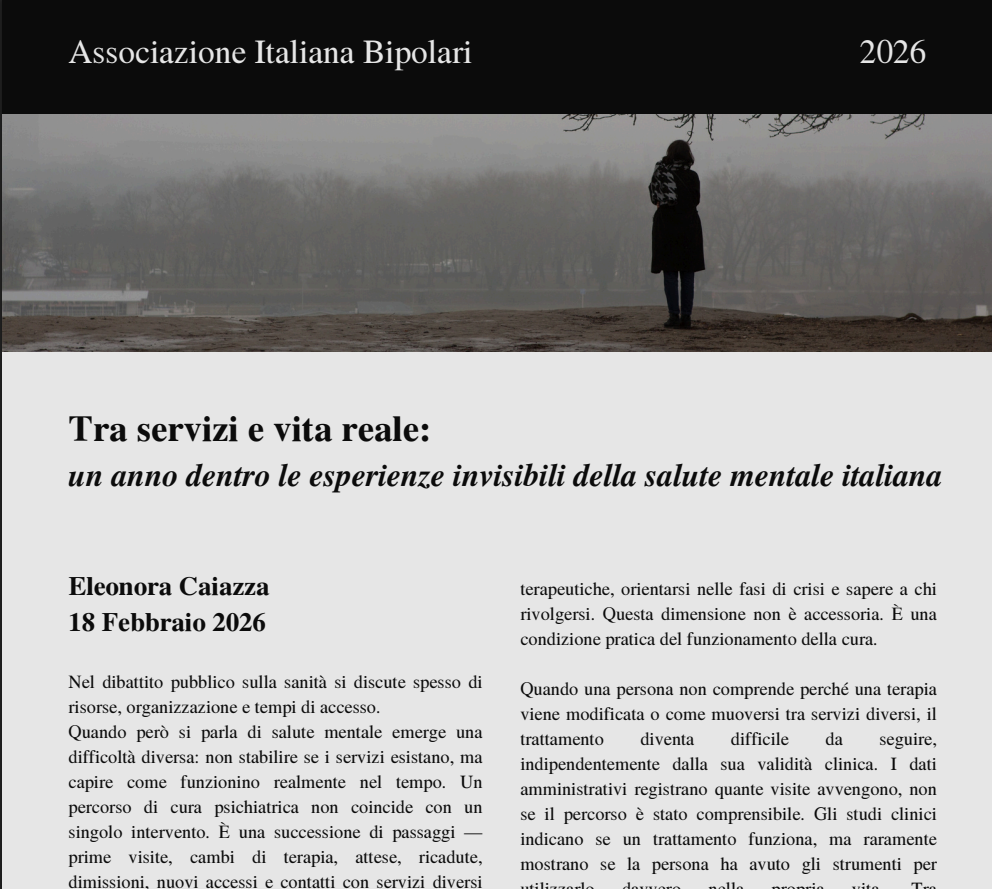
Between services and real life: a year exploring the unseen realities of mental health in Italy (italian only)